






Introduction
You set your SIP for the 5th of every month and assume your units are bought at the 5th's price. More often than not, that isn't quite what happens. Between the bank debit and the moment units land in your folio, a few quiet steps decide which NAV you actually get: your KYC status, your mandate, and SEBI's cut-off timings.
None of this is complicated once it's laid out. In this guide, we walk through how a SIP in mutual funds works from start to finish: what needs to be in place before you begin, what happens when you set it up, which date your units really carry, and what changes when you pause, stop or redeem. We've also added the latest 2026 updates, so you're working with current rules.
Main Content
1Before any money moves: KYC comes first
Before you start a mutual fund SIP, three basics need to be in place: a PAN linked with Aadhaar, a bank account in your own name for the debit mandate, and a one-time KYC done through a KYC Registration Agency (KRA). This single KYC record is then shared across fund houses.
What many investors miss is that your mutual fund KYC status isn't simply "done" or "not done". It sits in one of three states:
Your details are verified with official sources, and you can invest with any fund house.
Your KYC works for your existing folios, but to open a new folio, whether with the same fund house or a different one, you'll need to re-verify your KYC with the KRA.
Nothing goes through, not even your SIP instalments.
KYC on hold usually comes down to one of three reasons: PAN not linked to Aadhaar, an inoperative PAN or a name mismatch across records, or an email ID or mobile number that hasn't been validated. Each is easy to fix once you know about it, so check your status on a KRA website before your next instalment is due.
Check your KYC status here: CVL KRA – KYC Inquiry. Simply enter your PAN to see whether your KYC is Validated, Registered or On Hold.
Check KYC status →2Setting it up: folio, mandate and the first instalment
When you register a SIP, three things happen.
The fund house opens a folio number, which is simply your account with that AMC.
A SIP mandate (NACH, e-mandate or UPI AutoPay) is registered so your bank can debit the amount automatically.
Because mandate registration takes a little time, your first instalment may start later than the date you picked. That's normal, not an error.
3The date you actually get: SEBI cut-off times and NAV
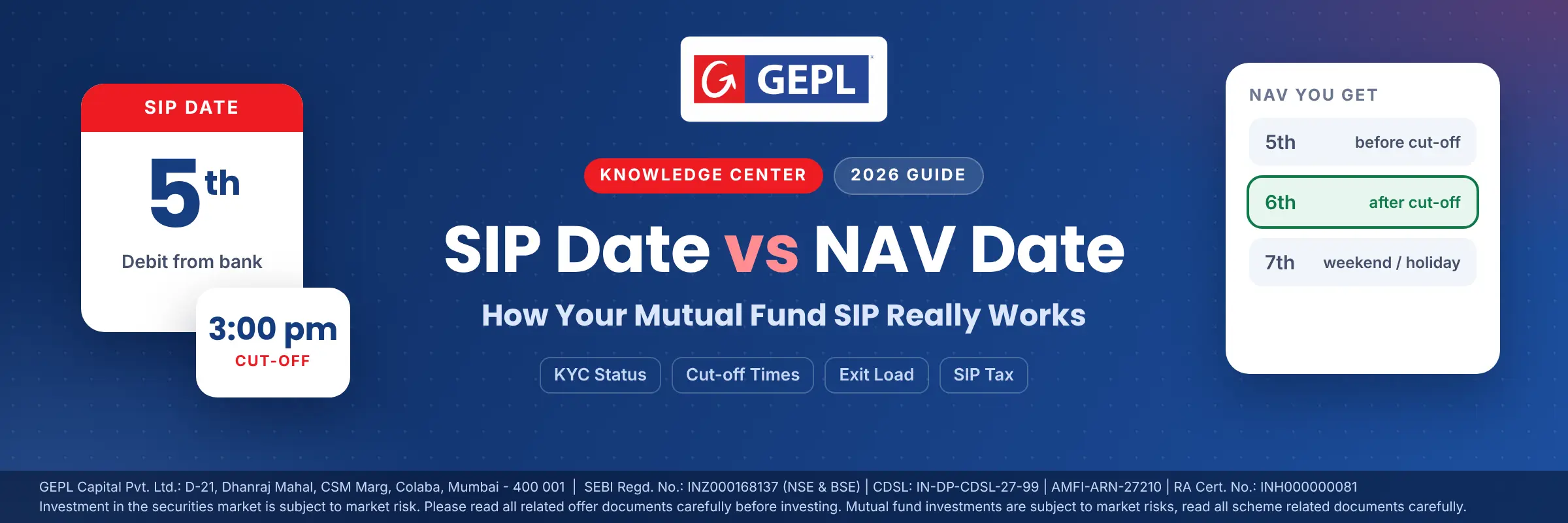
Here's the answer to the 5th-of-the-month puzzle. Your SIP NAV depends on when your money reaches the fund, not when it leaves your bank. As per SEBI rules, for purchases of any amount, the applicable NAV depends on the money being realised in the scheme's account before the cut-off time.
Current mutual fund cut-off times:
| Transaction | Cut-off time |
|---|---|
| Equity and debt funds: buying Buy | 3:00 pm |
| Equity and debt funds: selling Sell | 3:00 pm |
| Liquid and overnight funds: buying Buy | 1:30 pm |
| Liquid and overnight funds: selling Sell | 3:00 pm |
If the money lands before the cut-off on a business day, you generally get that day's NAV. If it lands later, the next business day's NAV applies. Liquid and overnight funds follow slightly different rules, so check the scheme document. This is why a debit on the 5th can show units at the 6th's or even the 7th's NAV, especially around weekends and bank holidays.
4Each instalment is its own investment
Every SIP instalment is treated as a separate investment with its own date.
If you remember just one idea, make it this one. That explains four things:
- Exit load on SIP is checked per instalment, not on the SIP as a whole.
- The one-year holding period for tax also runs separately for each instalment.
- Even a five-year-old SIP holds units bought last month.
- When you sell, the oldest units go first (FIFO, first in, first out).
Equity funds commonly charge an exit load of about 1% if units are redeemed within a set period, often 12 months from each instalment's date. The exact load and period vary by scheme, so check the scheme document.
SIP taxation for equity funds, as it stands for FY 2026-27 (Union Budget 2026 left these rates unchanged):
LTCG on mutual funds is taxed at 12.5% on gains above ₹1.25 lakh in a financial year.
Short-term gains are taxed at 20%.
Surcharge and cess apply as relevant, and debt funds follow different rules. Speak to a qualified tax professional for your own situation.
5Pause, stop or redeem: three different actions
People use these words interchangeably, but they mean very different things:
Instalments skip for a limited period, usually a couple of months, and then resume on their own. The maximum pause period depends on your fund house or platform.
Future instalments end, but the money already invested stays put and keeps working.
You sell units and take the money out. Exit load and tax may apply.
A useful update here: SEBI requires fund houses to process SIP cancellation requests within two working days, a rule in effect since December 2024. Even so, it's sensible to place your request a few days before the next debit date.
Conclusion
A SIP looks simple from the outside: pick an amount, pick a date, let it run. But knowing how KYC status, mandates, cut-off times and per-instalment rules work can save you from failed debits, surprise exit loads and unexpected tax. Check your KYC status today, confirm your mandate is active, and read the scheme documents to understand the exit load before you invest. And keep in mind that SIPs don't guarantee returns; they are a disciplined way of investing in market-linked products.
Ready to put this into practice? For your mutual fund investments, the GEPL MF app lets you start a SIP, track your folios and keep an eye on upcoming instalments, all in one place. For equity and other exchange-traded investments, the GEPL Pro Markets mobile app brings markets to your fingertips. New to investing? Open a Demat account online with GEPL Capital and begin your journey with clarity.
Frequently Asked Questions (FAQs)
1. Why didn't my SIP get the NAV of my SIP date?
Your SIP NAV depends on when the money reaches the scheme's account, not when it is debited from your bank. If it is realised after the cut-off time, or the debit falls near a weekend or holiday, the next business day's NAV applies.
2. What does KYC on hold mean, and how do I fix it?
KYC on hold means no transactions, including SIP instalments, can be processed. It usually happens when your PAN isn't linked to Aadhaar, your PAN is inoperative, your name doesn't match across records, or your email or mobile isn't validated. Fixing the underlying issue and updating your KYC with a KRA restores your status.
3. Can I open a new folio if my KYC shows "Registered"?
Not straight away. You can keep investing through your existing folios, but opening a new folio, with the same fund house or any other, needs your KYC to be re-verified with the KRA first. Upgrading to "Validated" lets you invest with any fund house without this step.
4. Is exit load charged on my entire SIP when I redeem?
No. Exit load on SIP is calculated per instalment. Only units still within the exit load period attract it, and because of FIFO, the oldest units are redeemed first.
5. How is SIP taxed in 2026?
For equity funds, units held over 12 months attract 12.5% LTCG on mutual funds on gains above ₹1.25 lakh in a financial year, while units held for 12 months or less attract 20% short-term tax. Each instalment's holding period is counted separately. Surcharge and cess apply as relevant.
6. What is the difference between pausing and stopping a SIP?
When you pause SIP, instalments skip for a set period and then restart automatically. When you stop SIP, future instalments end, but your existing investment stays invested until you choose to redeem.
7. How long does SIP cancellation take?
SEBI requires fund houses to process SIP cancellation requests within two working days. It's still wise to apply a few days before your next debit date.
8. What are the mutual fund cut-off times for liquid funds?
For liquid and overnight funds, the mutual fund cut-off time for buying is 1:30 pm and for selling is 3:00 pm. For other equity and debt funds, it is 3:00 pm for both.
Disclaimer
GEPL Capital Pvt. Ltd.: D-21, Dhanraj Mahal, CSM Marg, Colaba, Mumbai - 400 001
SEBI Regd. No.: INZ000168137 (NSE & BSE) | CDSL: IN-DP-CDSL-27-99 | AMFI-ARN-27210 | RA Cert. No.: INH000000081
Investment in the securities market is subject to market risk. Please read all related offer documents carefully before investing.
Mutual fund investments are subject to market risks, read all scheme related documents carefully.
These are not Exchange Traded Products. GEPL Capital Pvt. Ltd. acts only as a distributor. All disputes with respect to these products would not have access to Exchange Investor Redressal Forums or Arbitration Mechanisms.
This article is for education and information purposes only and does not constitute investment, tax or legal advice. Cut-off timings, exit loads and tax rules may change and vary by scheme; please check your scheme documents and consult a qualified tax professional.

.webp)